What to Tell the Kids When the Dog Can't Play, Heartworms vs your best friend
When your dog is on heartworm rest, your kids need answers too. Here's what to say — and a book that says it for young post description.
There’s a version of this diagnosis that the Heartworm Healing Guide covers well.
The sleepless owner. The 47 browser tabs. The 2 AM symptom spiral — is that coughing normal? is she supposed to be this tired? am I doing this right?
That’s the adult version of a heartworm diagnosis.
Then there’s the version nobody has a guide for.
It’s the seven-year-old standing at the back door, leash in hand, looking at Biscuit — who is lying in her dog bed doing exactly what the vet said she needs to do — and asking a question you don’t have a perfect answer to yet.
“Why can’t Biscuit play?”
The Hardest Conversation Isn’t the One with the Vet
When Biscuit tested positive, you had a lot to learn fast. Treatment options. Activity restriction. What the next 8–12 weeks would look like. Your vet walked you through the protocol. You left with a follow-up date and a pamphlet and an enormous amount to carry.
What the appointment didn’t cover: your kids.
Because children don’t process “rest protocol” and “cardiac risk during activity restriction.” They process the fact that Biscuit isn’t running with them anymore. They process the fact that something is different — that her leash is staying on its hook, that her bed is staying warm, that her tail barely moves — and no one has explained it in a way they can hold.
That silence — the unexplained change — is what produces the fear a child actually feels. Not the medical facts. The gap between what they see and what they understand.
A dog who usually zooms across the yard with her ears flying back like wings, now lying still. A dog who wants to come to the door — you can see it in her eyes — and can’t. That is confusing and a little frightening to a child, and it doesn’t have to be.
What Kids Understand (and What They Don’t Need To)
Children don’t need the clinical picture. They don’t need to know about microfilariae or what the treatment protocol involves or why physical exertion creates risk during recovery. Those are your things to carry.
What they need is a story.
They need to understand that Biscuit has something inside her that her body is working on. That the doctor gave her medicine to help. That is the most important thing Biscuit can do right now — the thing that helps her get better — is rest. And that rest, even though it looks like Biscuit is sad or bored or different, is how Biscuit wins.
They need to know there’s a reason. And they need to know the reason ends with Biscuit running again.
There’s also a second thing children need, and this one is easy to miss: they need to know they can still help.
When a dog goes on activity restriction, the whole house shifts around it. Walks get shorter or stop. Games of fetch don’t happen. The routines a child has built around their dog — the morning run, the backyard zoomies, the leash they’ve learned to clip on all by themselves — those routines go quiet. And children, more than adults, need to feel like they have a role.
The good news: they do. And it’s a real one.
Presence Is Not Nothing — It Is Everything
Here is something parents often don’t realize until they’re living it: calm, quiet presence is genuinely good for a dog in recovery.
Your child sitting beside Biscuit. Reading to her. Drawing a picture and taping it to the wall where she can see it. Breathing slowly, not bouncing or calling or jingling the leash. These are not distractions from healing. They are part of the healing environment you’re trying to build.
The dog who spent weeks on activity restriction and had a calm, steady child nearby — who learned to exhale slowly and just stay — that dog had something medicating her that no vet can prescribe. Presence. Constancy. Love without running.
That is not small. That is the thing.
When a child learns that still together is still something — that love doesn’t require action to count — they carry that forward. Long after Biscuit’s recovery is done.
The Moments You’re Going to Navigate
Here’s a practical run-through of what the next several weeks will actually look like, translated into child-sized pieces.
“Why can’t she run?”
“Because still is how she heals. Being still IS doing something — it’s the most important thing right now.”
This one answer does more work than ten explanations. Say it plainly. Sit down on the floor to say it, if you can. Kids hear calm through your body as much as your words.
“Is she sad?”
“She’s resting. Her eyes are warm. She can hear you. She likes having you close.”
Watch Biscuit’s eyes when your child is nearby. Dogs communicate a great deal through their eyes, and what your child will see there — warmth, presence, connection — will tell them more than you can.
“Is she getting better? I can’t tell.”
This is the hardest one, because recovery is invisible for a long time. The right answer: “Even when you can’t see it happening — it’s happening.”
Mark a calendar together. Let your child make small observations — does her head lift a little higher this week? Does her ear turn toward a sound? The signs of return are subtle and then suddenly obvious. Being the one who notices them first is a genuinely good thing to give a child to do.
“Will she be okay?”
Tell them the plan. Tell them the whole family is helping. Give them the effort — not a promise you can’t make for them.
The Days When It’s Hard
Some days the leash on the hook is just sad. Some days your child stands at the door for a long time and then walks away quietly and you don’t know what to say.
You don’t have to say everything. You can sit down beside them and Biscuit and just be still too.
One of the quietest, most important things you can give your child during this season is permission to feel the weight of it without panicking about it. The dog is in the fight. The dog is healing. Those look similar from the outside for a while, and it is okay to acknowledge that this is hard.
What’s also true: this is an unusual kind of hard that ends in joy.
Most hard things don’t come with a finish line as clear as this one. Heartworm treatment has one — and on the other side of it is the real possibility of a dog running again, better than before, together. That is worth waiting for. Teach your child to wait for it with intention.
That’s Why Why Biscuit Can’t Play Today Exists
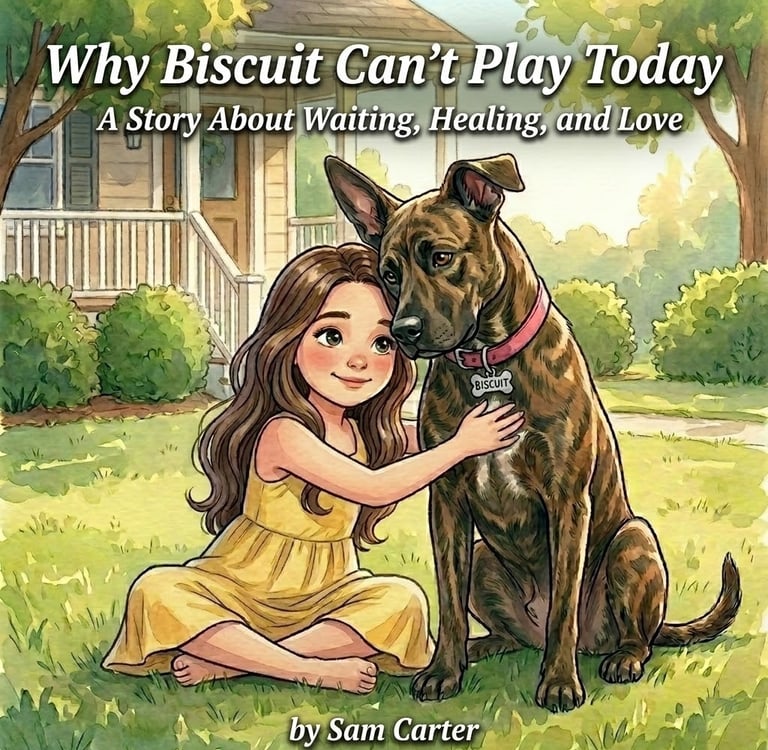
Why Biscuit Can’t Play Today is a children’s picture book written specifically for this moment — for the household where the dog is on activity restriction and the children in the house don’t understand why.
Maya is six. Biscuit is her dog. Biscuit can’t run, can’t jump, can’t chase the ball. The book follows Biscuit’s recovery — from the quiet days of rest to the moment she can play again — in language a child can sit with and a parent can read aloud without having to explain the parts they’re still figuring out themselves.
Maya learns that being still together is still something. She reads to Biscuit. She draws a picture — a dog with ears like wings — and tapes it to the wall where she can see it. She tells her: “That’s you. That’s who you’re going to be again.”
And then, weeks later, one morning, Biscuit is at the door. Tail going like a helicopter. Leash in her mouth. Eyes bright as two little moons.
The book ends where heartworm treatment ends: with the dog running, and the child running with her, ears flying back, full joy, together.
There are no other books like it. Every child’s book about pet illness is about grief. Why Biscuit Can’t Play Today is about healing — and it ends with Biscuit in full joy.
For Families Navigating This Together
If you have kids in the house while your dog goes through heartworm treatment, the resource for you is Why Biscuit Can’t Play Today — available on Amazon. Ages 4–8. Written by Sam Carter, author of the Heartworm Healing Guide.
For the adult side of the diagnosis — the treatment options, the symptom tracking, the activity restriction framework — the Heartworm Healing Guide is the companion resource built for the owner who wants to do this right.
Biscuit is doing her part. You’re doing yours.
And your seven-year-old, leash still in hand, waiting by the door — they’re doing theirs too. They just needed someone to tell them that.
Heartworm treatment outcomes vary. This post is not a prediction of your dog’s recovery — it is support for your family through the process.
— Sam Carter
Why Biscuit Can’t Play Today — a picture book for families. Ages 4–8.
© 2026 Exception Nation LLC. All Rights Reserved.
Get in touch
“This site is named in honor of Zuri’s story and is intended for orientation and support only. It does not suggest outcomes, methods, or treatment paths for heartworm disease.”
Sam Carter is a pen name used for privacy. This site offers decision‑support and lived experience, not medical advice. Read more from Sam Carter on Amazon.
Other information for you.